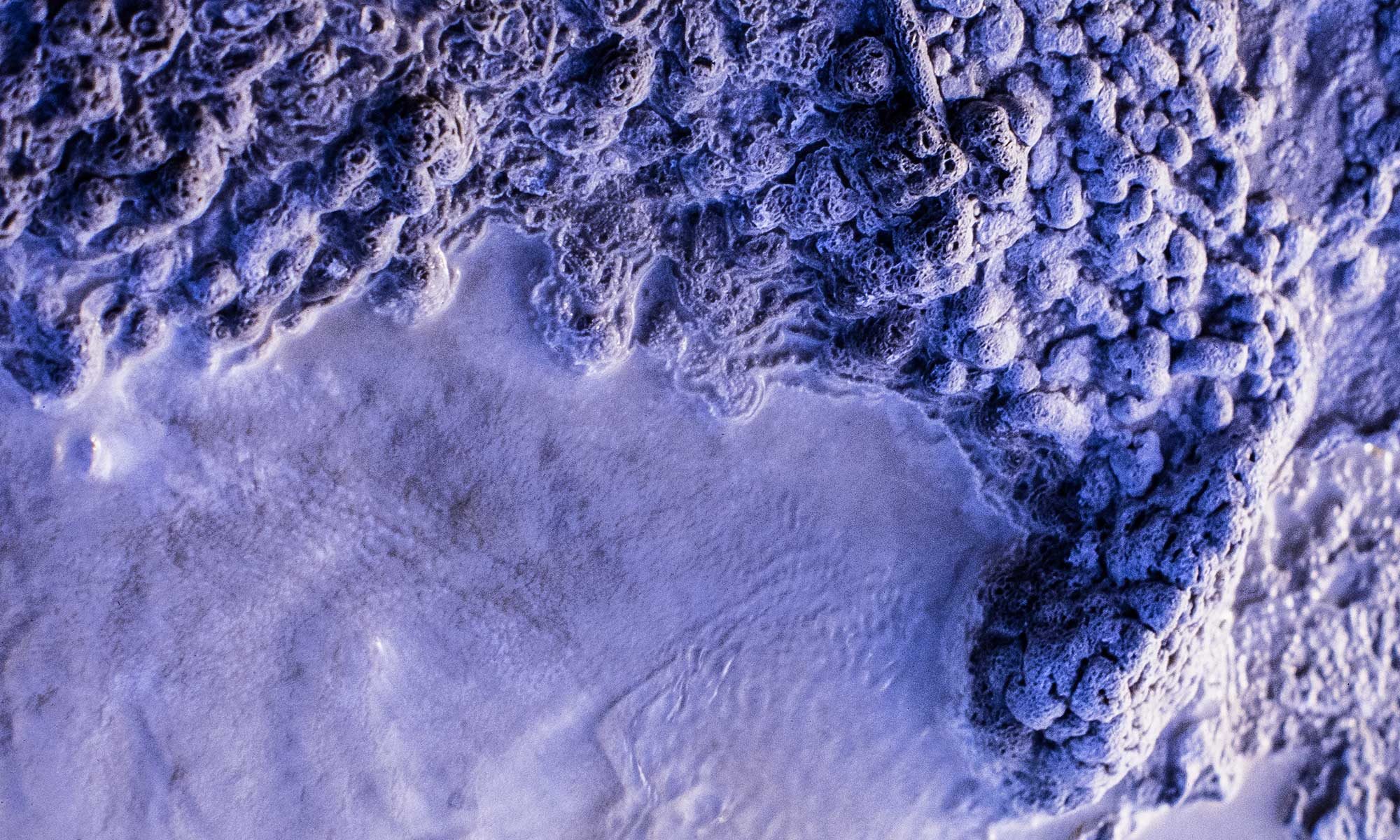
Mired

13 May 2012 - Leave a Response

The smell really didn’t bother me. I could still breathe without puking, if I didn’t inhale the hot vapor too deeply. I was conscious, so that was good. And it seemed I was able to move, although of course that wouldn’t have been a terribly good idea just then. Not in total darkness.

I recalled a bedroom. Mine, I guess, or somebody’s. It was pitch black in there and I had to get up to pee. I tripped and fell onto a piece of gear, like a backpack or something. Stupid.

So no moving here. Certainly not with that sound so close by. It was definitely not mechanical, although I have heard metal groan like that, when stressed to it’s Hooke limit, or was it the von Mises criterion? My brain was a mess. I knew trivia like that but not my own name.

The moaning was definitely organic. Not even the most sophisticated bio-mech simulation could replicate the soul behind a moan like that.

Or, I should say, moans. There were at least three. No, four. Crap, five. All around me. Were the moans getting louder? Were they coming closer?

I reached for my pistol. It wasn’t in my belt. I didn’t have a belt. I didn’t have pants. I was naked. No wonder it was so easy to float there, without the weight of my boots and equipment.

Floating, that what it was. Ok. I wasn’t afraid of the water. But this wasn’t water. It was too viscous, a syrup maybe. A really rank syrup. What or whoever was moaning was probably floating in it, too. Good. If they made a move for me, I would hear them sloshing or slurping or something. And then what? Swim away? Not very quickly, in this muck.

My skin was crawling. It started to itch. I scratched at a particularly tingly place on my chest, but that made it worse. A dull burning. Now I felt it everywhere, in some places – if you know what I mean – way worse than others.

I moaned. I didn’t care about revealing my position now. I didn’t care if the others came after me. They were probably in the same fix as me. I tried to call out, but my tongue was a slab of dead flesh.

I listened again. One groan seemed closer. I turned and tried to swim toward it. I reached out, groping at nothing.

I touched an arm. It pulled away, and I heard a sharp gasp. I tried to grunt an encouraging sound, and reached further. I found a shoulder. Whatever it was, the body felt like mine. A person. It didn’t pull away this time.

We joined hands. I started a one-handed swim toward another moaner, with this person swimming alongside me. We found a third, then a fourth, a fifth. Now what? It was still totally dark, with no visible escape.

Six of us swam in an arbitrary but single direction, with no other aim than to simply do something together, rather than stew there inertly alone.

An obstacle. Something solid. Slimy but solid. We climbed, pulling each other up, out of the morass, slipping and breathing heavily, with occasional grunts that sometimes sounded like laughter.

The air cooled as we climbed. Above us, in the darkness I thought I saw… Yes, a tiny speck of light, and then another, then hundreds, then millions.

-o-

Creative Commons License
The Syrup by Peter Mackey is licensed under a Creative Commons Attribution-NonCommercial-NoDerivs 3.0 Unported License.
Permissions beyond the scope of this license may be available at petermackey.us.

Synopsis: Hell or Heaven?

24 January 2012 - Leave a Response

I love writing a synopsis. There, I said it out loud.

Hard to believe, right? It is excruciatingly difficult to take 100,000 words and distill them into three or four hundred, or less, and still keep what remains sufficiently interesting. There is a famous quote by Mark Twain and others, which I will here bastardize: “I didn’t have time to write a synopsis so I wrote a novel instead.”

Writing a Synopsis isn’t just “work,”  it’s like murder.  All your secondary plot lines are disappeared with a stroke of the delete key. Vital supporting characters cease to exist. Subtlety and nuance? Vaporized. All the ingredients you had cooked together for readers to feast upon are sucked away – your seven-course meal of delight reduced to a common bowl half full of watery soup.

But hey, some people like bouillabaisse. And now, I realize, I do too. Hmm, maybe I’m having a cognitive dissonance moment, a Stockholm syndrome thing where, having been captive and put through hell, I’m in love with the devil now.

It can take dozens of total hours spread out over many days to come close to a sufficiently short synopsis. There will be aspects of the tale that cannot be left out, aspects that demand many sentences to describe. But in making those cut-or-keep decisions, you learn what is truly essential, and what is not. A good synopsis reveals the skeleton that holds the entire story together, that helps it walk, run, sit up straight, or lie down in a heap.

Being forced to distill key scenes from the story (Which ones are “key”, anyway? Hopefully every one.) into just a few words raises a crucial question, “Is that the essence of what really happens?” If removing something from the synopsis doesn’t seem to harm the understanding of the story, it also helps you answer another scary question, “Did I ever really need that at all?”

Be careful, though. What gets left out of a synopsis is often the very seasoning and complexity that moves your story toward art, an experience that comes to life in the mind of the reader. But that’s what the book is for. The synopsis is the tease, delivered without hype, that helps the full story find its readers – a tool that the agent, the editor, the reviewer can scan, and hopefully want to see more.

Writing a novel, you’ll spend maybe years crafting a landscape in intricate detail, sculpting it down to the last flower and pricker bush. But now, summarizing it, you are climbing a mountain and looking out over the entire work. See those peaks and valleys? Is that a rainforest out there, or a desert?

And, here’s my revelation: Why wait until the story is finished? Periodically stopping during your development process and writing a synopsis of what you’ve got so far can give you a high-level view of what you’ve accomplished, a perspective hard to achieve while you’re working on that gorgeous landscaping.

Infection

30 October 2011 - Leave a Response

The following is probably not entirely true… —The Editor

To say that authors of speculative fiction are agents of the future is to state the obvious. Sufficiently compelling ideas generated in the mind of a reader will most certainly influence his or her individual outlook to some degree, perhaps his or her future, and even more the world in which these readers live and have the power to change. Works which deal in alternate worlds, unimagined technologies, fantastic civilizations, and the magic of human possibility can’t help but be persuasive.

This agency of which I speak however does not – as we authors most hubristically believe – arise merely from sparks of insight triggered within our own meager brains. No. I say we are not the freethinking creators we imagine ourselves to be. Ladies and gentlemen, we have been infected.

Yes! The brains of speculative fiction authors are infected by quantum entangled microbes teleported from the future itself. And not just from one future, but from the multi-versal future worlds that are spawned by humanity’s random moment to moment choices here today. Into our writer-brains are targeted Planck-size wormholes, through which are conveyed synaptic viruses, which cast within us visions of these disparate possible worlds. We are infected with the stories of yet unborn creatures, of what could have been, and of what might be… teleported into us by beings beyond our comprehension.

No tinfoil hat can stop these implants, since teleported wormholes have no regard for matter in this universe. We have no choice but to write the stories these microbes compel us to dramatize.

And who or what is targeting us? Whence in the multiverse do these synaptic viruses come? It is not for us to know. Are they trying to warn us? To show us the way? Or do they wish to enslave us as their creative puppets, delivering their stories to hungry Earth-readers, and thus influencing the very futures in which these ineffable beings themselves reside?

I for one welcome my femto-wormhole-implanted synaptic virus from the multiverse. I plan to nurture it, feed it as much blood plasma is it demands, fulfilling its goal for me to be its voice here in this present… that many others may hear its words and take appropriate action.


Little Voices

14 July 2011 - Leave a Response

One of the first things you notice when embarking on a creative endeavor are all the little voices in your head. A beginner’s head, especially, is full of advice, and rules, and lists of do’s and dont’s. For a new writer, there’s an entire industry out there, in case you hadn’t noticed, bent on helping you become published and/or more successful.

Now, I’m not saying all these how-to advice books and columns of tricks aren’t helpful. It’s a common saying that when starting out, one first needs to learn the rules, only to know better how to to break them. And that’s fine. I like to think of that as surveying the terrain. But there are so many boulders, and trees, and fences, and hyenas out there, it is sometimes kinda’ tough to see the landscape.

What advice is useful and important, and what advice is simply tying you down, boxing you in, and caging your creative spirit?

And before you think I’m just a cranky rebel (which I am, but not only), I am not talking about little things like spelling and grammar, the very basics of constructing cohesive verbal communication. Those are rules you need. You wouldn’t want to live in a house built by a bunch of dudes who didn’t know how to drive a nail straight into a piece of wood.

You can’t break the rules if you don’t know what they are.

A common observation is that the most brilliant creative insights often occur when you’re not thinking at all – when you’re not worrying about following rules or planning a plot or staring at a dictionary definition. The flash happens while you’re doing something mundane like brushing your teeth or washing dishes (anything with water, apparently) – times when your mind is free and all those little synapses up there can do their natural work, making surprising connections that logic and rules would never have allowed you to make.

Just stop thinking and the answer will come to you. (That, by the way, is a pretty neat trick if you’re trying to remember something, in case you hadn’t already discovered the technique. Calm down your brain. It knows what to do.)

Well, sometimes. If I haven’t loaded my world and my characters with rich detail, no “sit back and wait for the magic moment” scheme is ever going to work. I think they call that preparation. If I have done the homework, then the little voice I hear in my head is often the voice of one of the characters, or something in the environment, or the clash of two issues. That’s what keeps me writing. It’s a superb moment.

Oops, I just mentioned a rule. Preparation.

We will never be completely free of the problem, I guess, knowing exactly how to filter-out which voice to listen to and which voice to ignore. But, chances are the seasoned professionals have discovered the secret. And I’m willing to bet it wasn’t spelled out for them in a commentary like this one.

Excelsior.

-o-

PS: That said, here are some books on writing
which I found exceptionally inspiring:

David Gerrold. Worlds of Wonder: How to Write Science Fiction and Fantasy.
Orson Scott Card. How to Write Science Fiction and Fantasy.
Ray Bradbury. Zen in the Art of Writing.

Side Effects

8 June 2011 - Leave a Response

As a result of interacting with this site, you may become…
…hungry
…sentient
…convoluted
…a gym teacher
…allergic to sunlight
…analog
…able to see the difference between film and video
…an etch-a-sketch artist
…redundant
…an organ donor
…fluent in Latin
…a god-parent
…a drywall enthusiast
…sensitive to the solar wind